
The history
The Smethport story: how magnet dust became a toy
Two brothers, a grinding floor full of iron dust, a borrowed army technique and the buyer who ordered six dozen boxes just to prove they would not sell.
A factory with a dust problem
Smethport is a small town in the Pennsylvania hills, and in the early 1950s its specialty company made magnets. Grinding magnets throws off iron dust, and iron dust near magnets does not sit still. It jumps, crawls and gathers itself into little bristling clumps on every surface of the shop floor.
Most people swept it up. James Herzog, whose family ran the place, watched it move instead. The dust followed a magnet the way iron filings follow one in a school demonstration, and somewhere in that twitching pile he saw hair.
The bubble was the hard part
A face you decorate with iron dust is a nice idea with an obvious flaw: loose iron dust. Send that home in a flat envelope and it ends up in the carpet by Tuesday.
The fix came from his brother. Donald Herzog had worked with vacuum forming on army radar equipment, a way of heating a plastic sheet and sucking it tight over a mold. Applied to a printed card, it made a clear dome with the powder sealed inside, and the toy suddenly worked: you could shake it, drop it, mail it, and nothing came out.
The face itself was painted by Leonard Mackowski, an artist from Bradford, one town over. A round bald head, a big nose, a patient expression. Willy has looked mildly surprised about his baldness ever since.
Worst toy of the year
The toy trade hated it. At the New York toy fair, buyers reportedly ranked it among the worst toys of the year: too simple, too cheap-looking, no moving parts to point at. It went on sale anyway at 29 cents, mostly out of stubbornness.
Then a buyer for the G. C. Murphy dime-store chain ordered six dozen boxes with the stated goal of proving to the salesman that they would not move. They sold out in days. The follow-up order was for twelve thousand, and the factory spent the next years trying to keep up.
Seventy years of the same board
The numbers since then are the kind most toys never see: more than 75 million boards sold, and a place on the industry lists of the top toys of the century, with Willy holding down 1955.
The company changed hands along the way. Patch Products bought Smethport Specialty in 2008 and kept printing the toy under its own banner; in 2016 Patch renamed itself PlayMonster and the box art changed again. The board under the bubble never did. The one on sale today matches the one from the Eisenhower administration, powder and all, which is roughly the point of buying it.
Boards this guide keeps mentioning
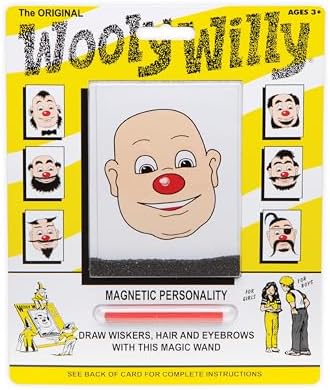
Original Wooly Willy
The current PlayMonster box of the 1955 magnetic drawing toy, and the listing most people land on first.
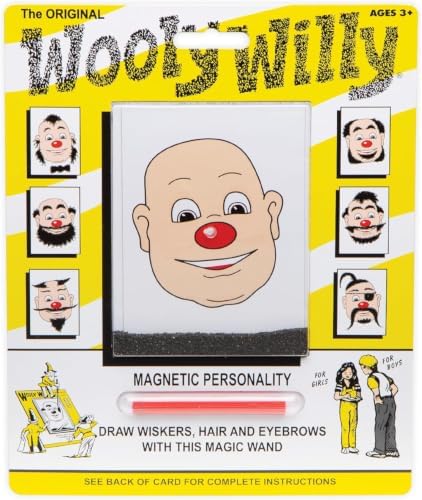
Wooly Willy: travel and gift listing
The newest listing on the shelf, pitched at road trips, party bags and the bottom of a stocking.